
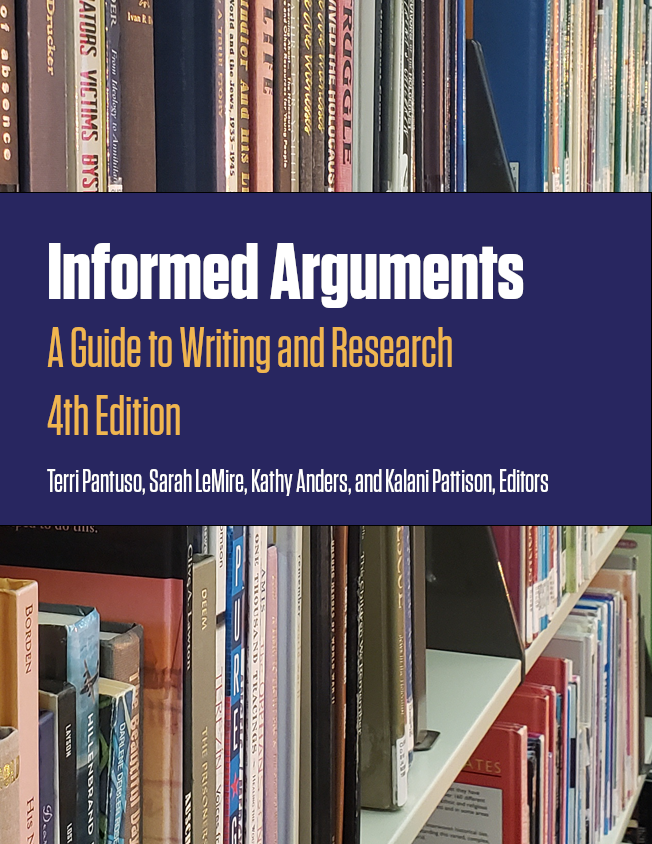
Book Title: Informed Arguments: A Guide to Writing and Research
Subtitle: Fourth Edition
Download this book
Book Description: Informed Arguments: A Guide to Writing and Research(4th Edition) is a premier Open Educational Resource (OER) designed to bridge the gap between critical thinking and rhetorical mastery. This edition refines the art of academic inquiry, offering students a transparent and accessible framework for deconstructing complex claims and constructing evidence-based positions. By prioritizing digital literacy and diverse perspectives, it empowers learners to navigate today’s information-saturated landscape with analytical precision. Comprehensive yet concise, this textbook remains an essential, cost-free solution for fostering scholarly voice and civic engagement in the modern composition classroom.
Contents
Book Information
Book Description
Informed Arguments stands as a cornerstone in the Open Educational Resource (OER) movement, providing a sophisticated yet highly accessible pathway for students to master the complexities of college-level writing. Now in its 4th edition, this textbook has been meticulously updated to reflect the shifting dynamics of modern discourse, moving beyond simple persuasion to focus on the ethics of inquiry and the responsibility of the researcher. It is designed not just to teach students how to “win” an argument, but how to contribute meaningfully to a community of ideas.
Comprehensive Coverage for the Modern Scholar
The text is structured to take students through the entire lifecycle of a project—from the initial spark of curiosity to the final polish of a cited manuscript. Key areas of focus include:
Critical Reading and Analysis: Teaching students to move beyond the surface level to identify underlying assumptions, logical fallacies, and rhetorical appeals (Ethos, Pathos, and Logos).
The Research Ecosystem: A deep dive into modern information literacy, guiding students through database navigation, the evaluation of “fake news” and algorithmic bias, and the nuances of primary versus secondary sources.
Synthesis and Voice: Specialized chapters on how to weave diverse viewpoints together without losing the student’s own unique scholarly argument in the process.
Documentation and Ethics: Clear, updated guidance on MLA and APA formatting, with a focus on the ethical implications of citation as a form of “giving credit” within a global conversation.
Pedagogical Innovation and Flexibility
This edition places a renewed emphasis on multimodal composition, recognizing that arguments in the 21st century often take the form of visual essays, podcasts, or digital presentations. By removing the financial barrier of traditional high-cost textbooks, Informed Arguments ensures that every student starts on day one with the tools they need to succeed.
The 4th edition also introduces expanded sections on inclusive rhetoric, encouraging students to engage with diverse perspectives and recognize the cultural contexts that shape how arguments are received. It is an ideal primary text for First-Year Composition (FYC), Advanced Composition, or any course that prioritizes critical thinking and evidence-based writing.
Book Source
This book is a cloned version of Informed Arguments: A Guide to Writing and Research by Terri Pantuso, Sarah LeMire, and Kathy Anders, published using Pressbooks under a CC BY-NC-SA (Attribution NonCommercial ShareAlike) license. It may differ from the original.
License

Informed Arguments: A Guide to Writing and Research Copyright © 2023 by Terri Pantuso, Sarah LeMire, Kathy Anders, and Kalani Pattison is licensed under a Creative Commons Attribution-NonCommercial-ShareAlike 4.0 International License, except where otherwise noted.
Subject
The Arts