Felicia Hemans (1793-1835)
“The Last Song of Sappho” (1831)
Editorial Introduction
Felicia Hemans’ poem “The Last Song of Sappho” is an influential work in Victorian poetry, and more specifically, in queer Victorian poetry. A biography from the Poetry Foundation tells us that “In antiquity Sappho was regularly counted among the greatest of poets and was often referred to as ‘the Poetess,’ just as Homer was called ‘the Poet’.” Plato hailed Sappho as “the tenth Muse,” and she was honored on coins and with civic statuary.
Nonetheless, an ancient, scurrilous tradition attacked and ridiculed her for her evident sexual preferences. Indeed, the facts of her life have often been distorted to serve the moral or psychological ends of her readers. An Anacreontic fragment that was written in the generation after Sappho sneers at Lesbians. Sappho was lampooned by the writers of New Comedy. Ovid related the story of Phaon, who, according to some traditions, rejected Sappho’s love and caused her to leap from a rock to her death. Christian moralists pronounced anathemas upon her. Many modern editors have exercised “gallantry” and “discretion” by eliminating or changing words or lines in her poems that they believed would be misunderstood by readers. This history of her reception is itself part of Sappho’s significance” (“Sappho,” Poetry Foundation).
By establishing Sappho as one of the earliest poets who pushed the boundaries of thought surrounding sexuality, we can see that Hemans was doing the same by writing about Sappho during a time when any exploration of thought beyond the norm was seen as a kind of societal rocking of the boat. This exploration of material that would more than likely be seen as controversial was likely personally important to Hemans, but it was also important to society as a whole. Any instance where a piece of queer media or information about a queer person survives to the present day is another moment where modern queer scholars can prove that queerness has been present throughout the entirety of history.
Works Cited
Poetry Foundation. “Sappho.” Poetry Foundation, Poetry Foundation, 2019.
Resources
Annotations are available for this poem. To learn how to view them, please see the How To View and Use Hypothesis Annotations help page.
Publication Context
Felicia Hemans’s “The Last Song of Sappho” as it appeared in Blackwood’s Edinburgh Magazine 29:175, 129, January 1831.
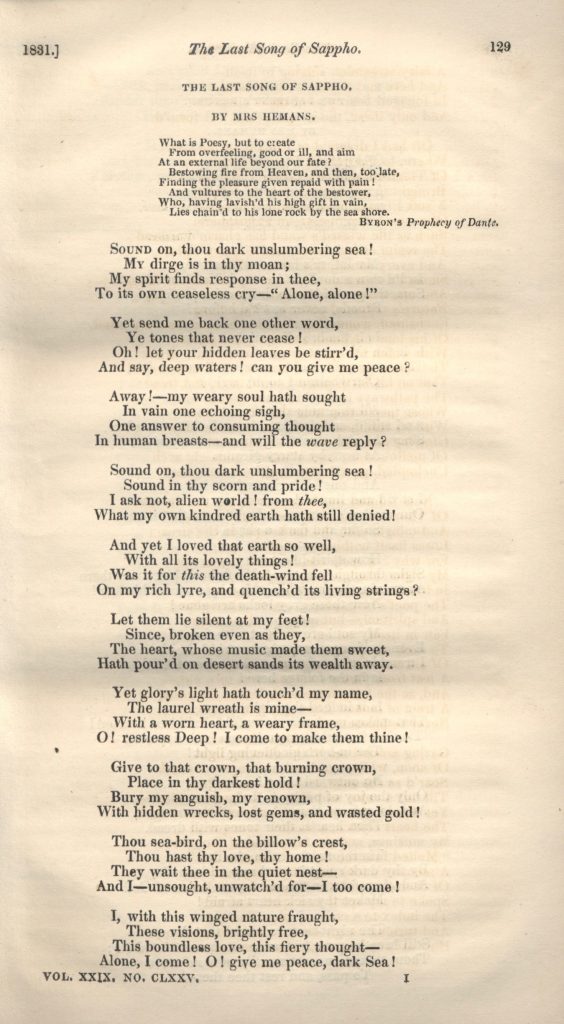
SOUND on, thou dark unslumbering sea!
My dirge is in thy moan;
My spirit finds response in thee,
To its own ceaseless cry–‘Alone, alone !’
Yet send me back one other word,
Ye tones that never cease !
Oh ! let your secret caves be stirr’d,
And say, dark waters! will ye give me peace?
Away! my weary soul hath sought
In vain one echoing sigh, 10
One answer to consuming thought
In human hearts–and will the wave reply ?
Sound on, thou dark, unslumbering sea!
Sound in thy scorn and pride !
I ask not, alien world, from thee,
What my own kindred earth hath still denied.
And yet I loved that earth so well,
With all its lovely things!
–Was it for this the death-wind fell
On my rich lyre, and quench’d its living strings? 20
–Let them lie silent at my feet !
Since broken even as they,
The heart whose music made them sweet,
Hath pour’d on desert-sands its wealth away.
Yet glory’s light hath touch’d my name,
The laurel-wreath is mine–
–With a lone heart, a weary frame–
O restless deep ! I come to make them thine !
Give to that crown, that burning crown,
Place in thy darkest hold! 30
Bury my anguish, my renown,
With hidden wrecks, lost gems, and wasted gold.
Thou sea-bird on the billow’s crest,
Thou hast thy love, thy home;
They wait thee in the quiet nest,
And I, the unsought, unwatch’d-for–I too come!
I, with this winged nature fraught,
These visions wildly free,
This boundless love, this fiery thought–
Alone I come–oh ! give me peace, dark sea! 40